
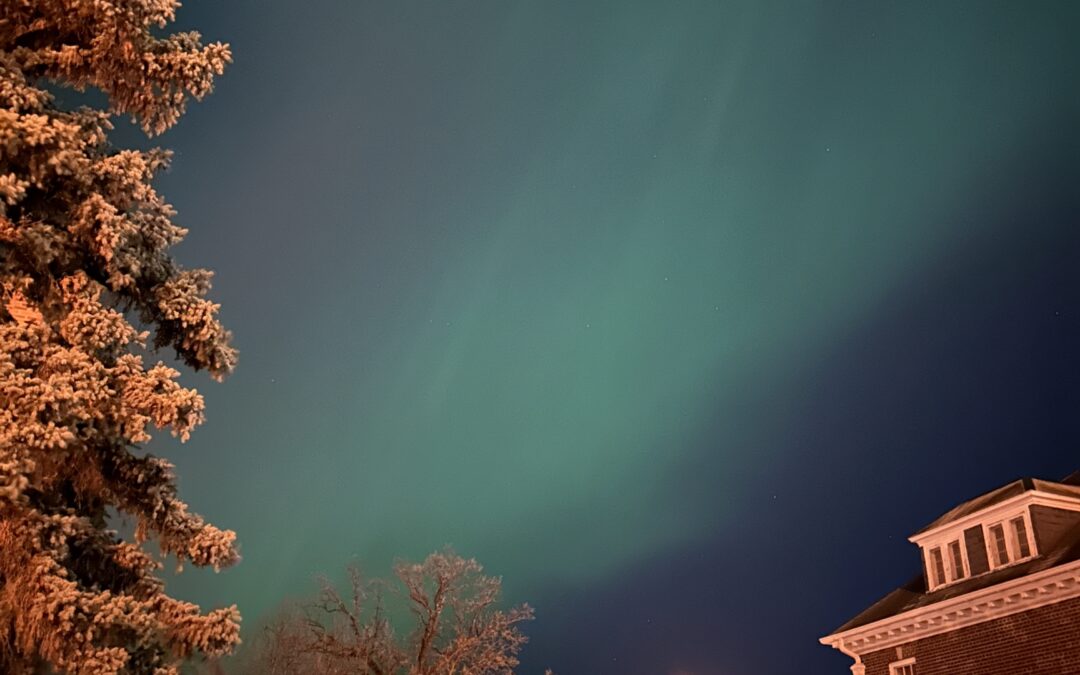
Article by Abigail Crawford (Thumbnail picture courtesy of Marcus Walker)
On November 11th, 2025, NOAA issued a G-4 level geomagnetic storm watch and a high potential for auroras. As the night went on and auroras began to appear all over the country, the watch was upgraded to a geomagnetic storm warning. The auroras were strong enough to be spotted here at Saint Cloud. This is unusual as Saint Cloud is a fairly urban area with substantial (although not as bad as some areas) light pollution, which can damage the ability to see the sky clearly.
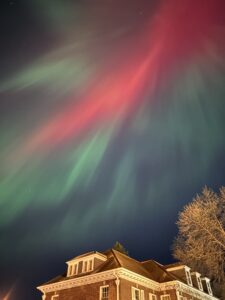
(Above: The aurora as seen just outside Mitchell Hall, in the parking lot. Photo courtesy of Marcus Walker.)
What is an aurora?
Aurora Borealis, also known as the northern lights, is a space weather phenomenon that occurs when masses of plasma are ejected from the outer layer of the sun. When this matter arrives to earth, it interacts with the gases in our atmosphere, colliding with gas particles high in the sky, leading to bright colors dancing through the sky. These reactions occur in bands and come in a variety of colors, ranging from green to blue to bright reds and purples.
The strongest of these storms are usually from a specific disturbance known as a coronal mass ejection (CME), where about a billion tons of plasma are ejected and sent towards Earth. Although it usually takes several days to reach us, they can also reach Earth in less than a day.
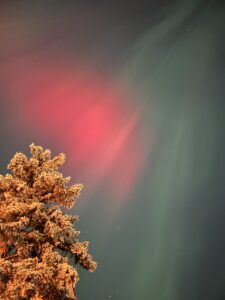
(Below: A brightened picture of the aurora from Mitchell Hall. Photo courtesy of Marcus Walker.)
Why have we been getting so many solar storms?
The sun is currently at its most active part of its 11-year cycle. The G-4 level watch was expanded to the 13th of November, as there is still detected activity. This could lead to more auroras both tonight and tomorrow.
Should we be worried?
Not really. In most situations, geomagnetic storms are harmless to life here on Earth. However, they can cause damage with power grids and communications such as radio signals if the storm is particularly strong. For most of us earthlings, the effects of a geomagnetic storm are limited to noticeable aurora.
How can we see the aurora here on SCSU campus?
Several groups of people, especially those at Mitchell Hall, took post-dusk walks out around campus, hopeful to see the lights. Some ended up walking to the dam, just south of campus, in order to get a clear view without the trees in the way.
The first signs of visible aurora came just after sunset, and continued throughout the night, the intensity of the lights ebbing and flowing. Around 8:30 pm, a major surge in colors flooded the skies above Mitchell Hall, hues of green and red swirling overhead with visible motion, even through the bright glow of the street lights. Purple tints also flowed through, the different colors indicating different gases and different atmosphere altitude of collision with solar particles. Green, the most common color, is associated with oxygen at lower altitudes. Red is rarer, and occurs when oxygen is collided with at a much higher altitude. Blue and purple come from nitrogen primarily, and at lower altitudes.
In addition to the aurora, the night was also fantastic for stargazing, with a gorgeous clear sky; as an extra bonus, the Northern Taurids meteor shower was also at its peak, so a few lucky people got to see a shooting star last night as well. Jupiter and Saturn also shone bright, so even after aurora activity had diminished, you could still see a lightshow.
As a relatively uncommon blessing from the stars, the aurora borealis never fails to dazzle the inhabitants of earth, and with this current active peak in the sun’s cycle, we are sure to receive a few more aurora before the next year or so.
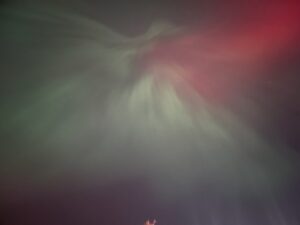
(Above: Aurora swirling as seen above Mitchell Hall. Photo courtesy of Bryan Erickson.)


Recent Comments